
Sorry, Novel. I Wrote Something Else.
How a Claire Fuller writing challenge led me to an unexpected gothic story

I finished this week with a complete story that I hadn’t planned on writing until Monday morning.
I’d signed up to the Arvon 5-day writing challenge. Each day started with an email containing a task set by Claire Fuller. I had just finished reading Hunger and Thirst and was on a Claire Fuller high, so I was already excited by the prospect of the challenge.
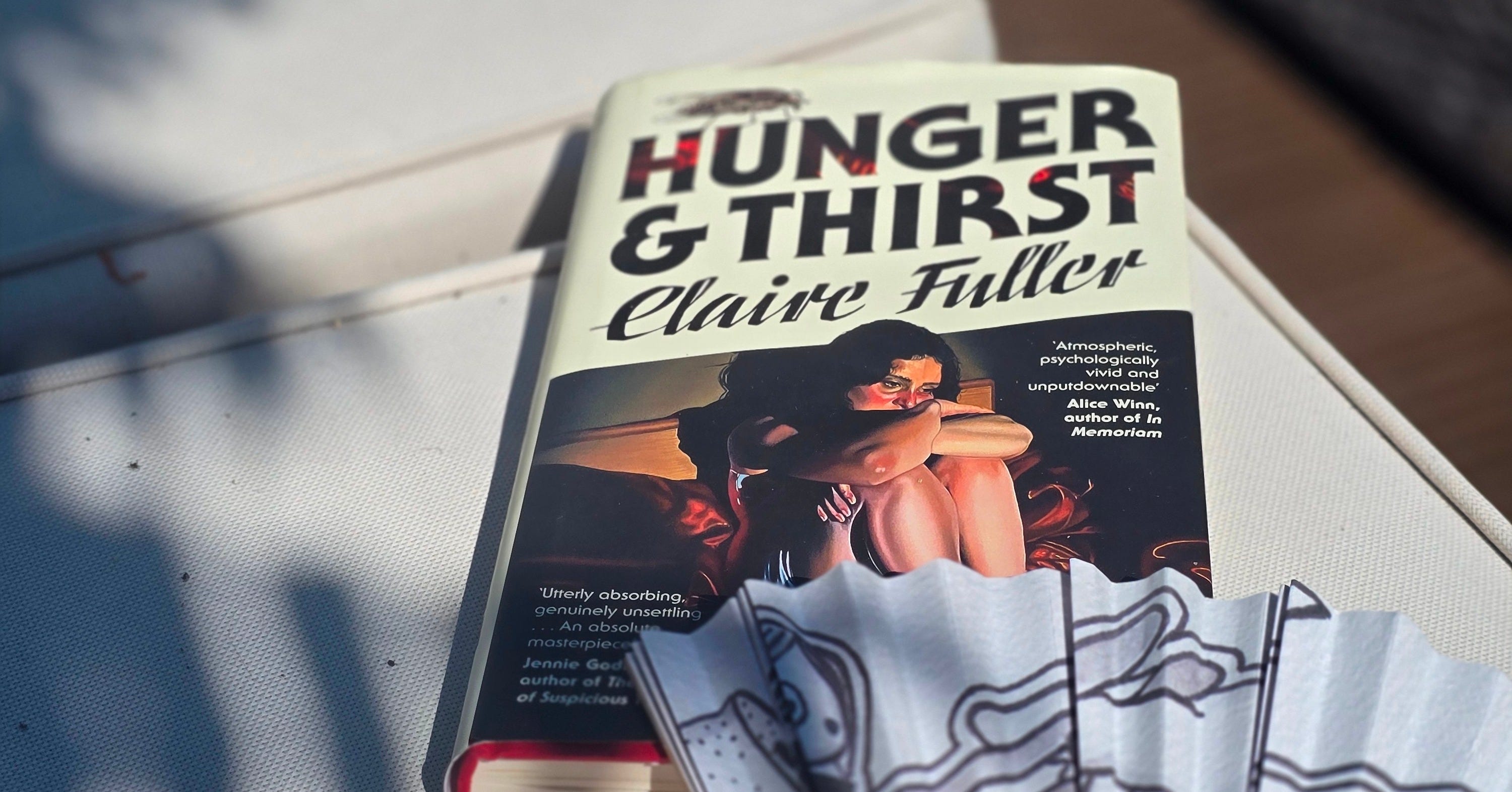
I loved the ambiguity in Hunger and Thirst, the way it made me question what was real and what wasn’t. I hadn’t set out to write something in that style, but looking back, I think it must have influenced me on some level. The tension between what we believe and what might actually be true had clearly found its way into the story I wrote this week.
My expectation of the challenge week was this: each day we would receive a different creative writing prompt to get our brain juices flowing and to get people in the habit of writing regularly. I imagined I would have five fun, but probably unusable, disconnected pieces of writing. And that would have been absolutely fine, because the point was the act of writing itself, not necessarily what was produced.
My expectations were wrong.
I ended the week with a finished gothic psychological thriller short story of 7800 words (or is that a novelette?). That was very much not on my July bingo card.
(I must take a moment here to send my sincerest apologies to my 105,000-word speculative fiction novel, which was sat in the corner all week waiting patiently to be edited.)
Let’s look at how the week went:
Day One:
The first exercise was to pick up a novel I had read recently and use a random number generator to select a page, and then again to choose a random paragraph on that page. Then, setting a timer for five minutes, I had to take the first full sentence of that paragraph as my opening line and write from there without inhibition until the timer sounded. No stopping to think, correct, or edit.
I chose Rebecca by Daphne Du Maurier, which I had recently finished (I was going to use Hunger and Thirst but didn’t want to seem like too much of a fangirl).
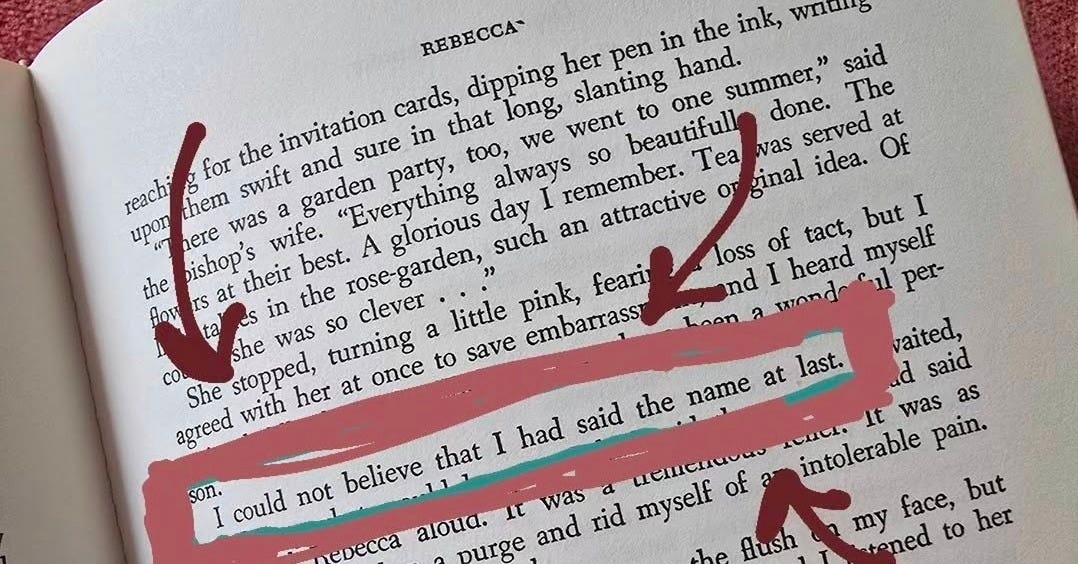
The line that was randomly selected was:
I could not believe that I had said the name at last.
Now, anyone who has read Rebecca will know that is a WILD sentence to have randomly picked. It is, in many ways, the premise of the entire book. It immediately set off a chain reaction of ideas for me.
I cheated already on Day One because I attended a The Writer’s Journey session (led by Robbie Westacott) , so I knew I had an hour of uninterrupted writing time and I decided to use that to constantly write for this challenge, instead of the five minutes suggested.
As I wrote, I realised I was channelling some of the atmosphere of Rebecca, and that my writing style had naturally slipped into gothic territory, which is new for me, but something I had been wanting to explore for a while since attending a talk by C.J. Cooke.
I knew I wanted to pay homage to what makes Rebecca so compelling: the power of a person’s presence and the way they can come to dominate a story. A person whose influence reaches far beyond themselves, shaping the thoughts, actions and fears of everyone around them.
That first day I wrote 1250 words.
Day Two:
This exercise was about finding the ending sentence by using the same random generator technique. This is when it clicked – oh, we are working on a cohesive piece across the week here!
By this point, I had a just over a thousand words on the page, and the story was unfinished and chaotic. I had never written short stories before so my gut instinct was to include a lot of detail and dialogue, and I had no idea how I would wrap the story up.
The chaos was exactly what Claire had encouraged us to embrace. First drafts are rarely neat - they are about following ideas and seeing where they lead.
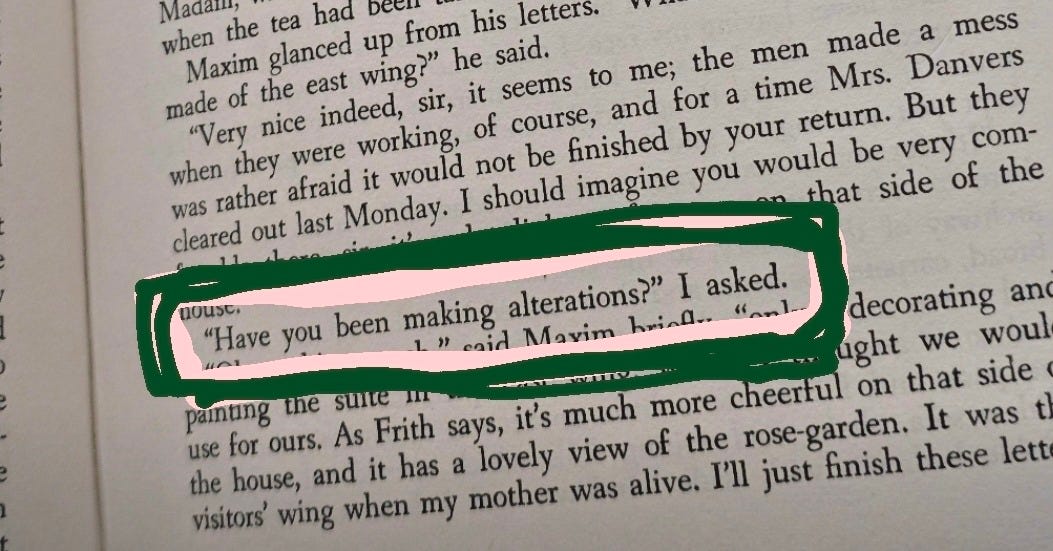
The sentence I randomly generated was:
“Have you been making alterations?” I asked.
Hm. Not the ending sentence I would have chosen! But in the spirit of the task, I didn’t pick another one (How many of you would have? I’m looking at you)
Instead, I trusted the process and accepted the strange little curveball I had been given. After all, the whole point of the exercise was to write without controlling every element.
So finally, I had a destination. I spent the time on Day 2 allowing the story to unfold, working towards that final line and seeing whether the ending I reached felt natural. It was interesting allowing a random sentence to shape the conclusion of a story that I hadn’t even planned to write a few days before.
It made me think that maybe some of my planning holds me back.
By the end of Day 2 I had 2800 words. I hadn’t quite managed to get a firm link to that final sentence, the end was a rushed few sentences that didn’t make much logical sense. But I didn’t overthink it!
Day 3:
The next stage was to look at the story with fresh eyes. Claire encouraged us to read our work aloud, which I always find helps with my writing as hearing the words spoken can reveal things that are easy to miss when reading silently. It can show where the story flows and where it stumbles and, worryingly often, where I’ve just left out key words.
The focus was not on polishing the language yet, but on stepping back and looking at the bigger picture. Did the story begin in the right place? Was there enough momentum? Did it actually feel like a story rather than a collection of scenes? Was the point of view working? This is exactly the stage I’m wrestling with in my novel at the moment, and I realised how naturally I gravitate towards tweaking individual sentences instead of looking at the bigger picture. I am, at heart, a detail orientated gal.
I read the story aloud to my sister, who was also taking part in the challenge, and it quickly became obvious that although I’d written a lot, I still hadn’t really moved the plot forward. I knew where I wanted it to go - I wanted people to die - but so far, no one had died yet. How dare they. It was time to stop expanding the world and start driving the narrative towards its conclusion.
My sister, meanwhile, had somehow produced a beautifully complete piece of flash fiction that reminded me of Virginia Woolf.
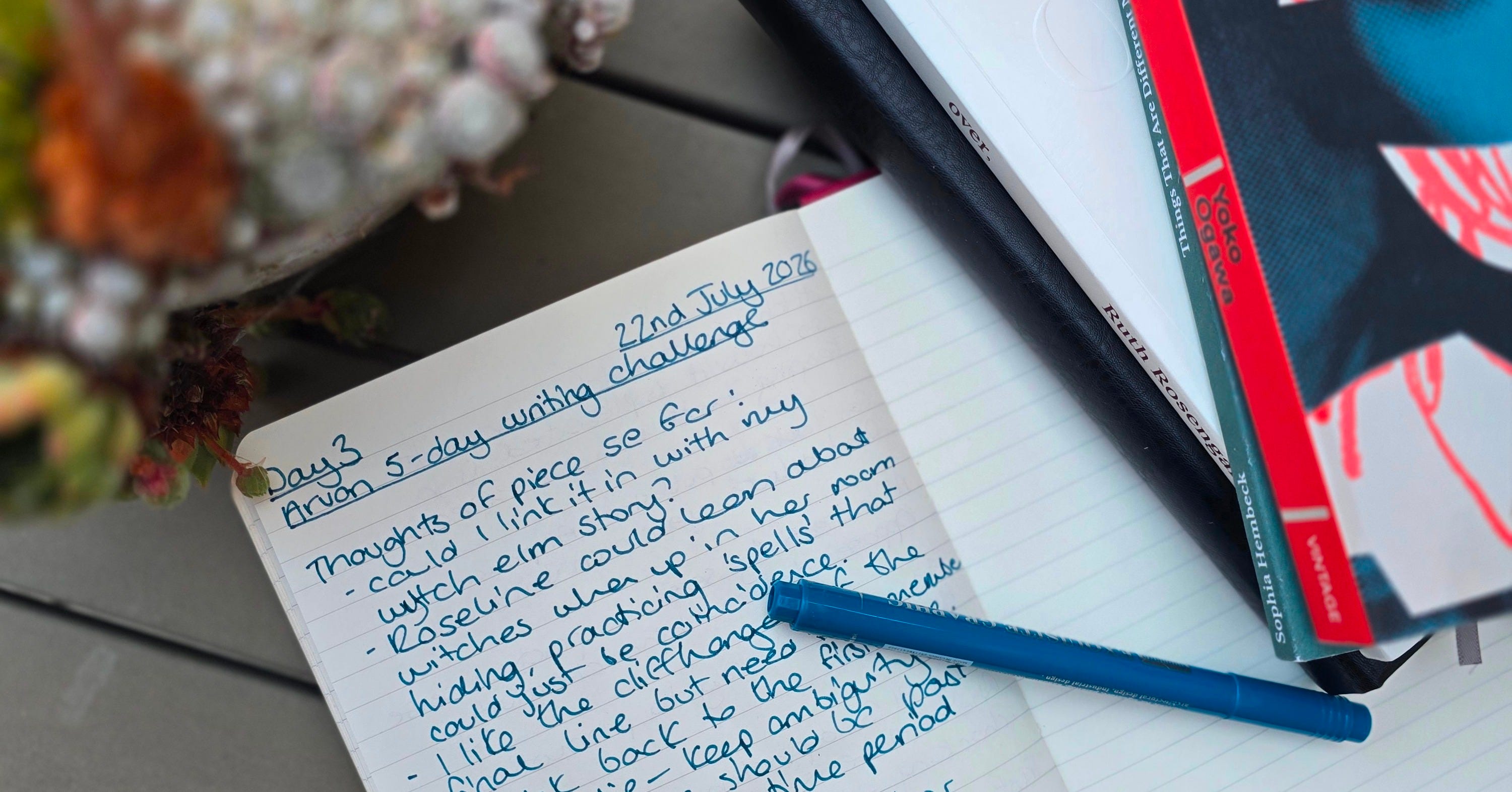
Rather than obsessing over individual sentences, I made notes about the structure, shifted a few scenes around, and started thinking about pacing instead of prose. The word count barely changed that day, but the story itself became much clearer. It was a useful reminder that writing is not just about producing words on a page, it is about shaping those words into an actual story.
Day Four:
Day Four continued with a closer look at what was happening beneath the surface of the story. By this point, I had generated ideas, found an ending, and started reshaping the draft into something more complete. The next step was to look beyond the structure and think about the deeper elements that would make the story work.
I read my story aloud again and considered whether the changes I had made earlier were actually improving it. I asked myself questions about my characters and their motivations.
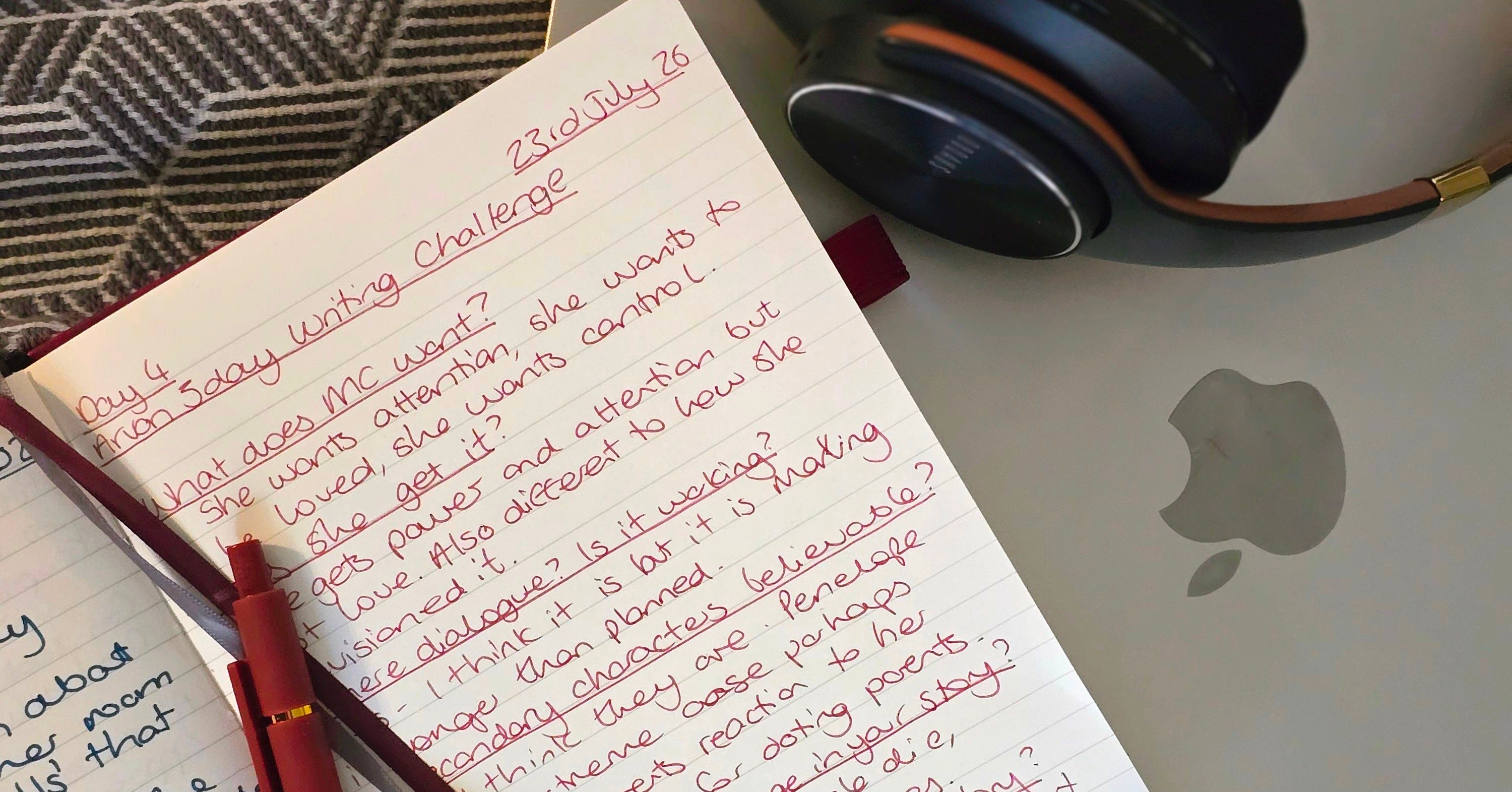
As before, I made notes as I went, scribbling down ideas and identifying areas that needed more attention. I then implemented these changes, and I wrote. A lot. Because, guess what, I had another The Writer’s Journey session, which gave me an hour of accountability.
By the end of Day 4, I had around 5800 words. I had connected the main point of my story to the ending, and I had sharpened up some of the dialogue to be in keeping with the decade I was setting it in, the 60s. I was starting to think that I was actually producing something I could be kind of proud of.
Day Five:
I wasn’t able to do Day 5 on the Friday because I was out until late, and I won’t like – that made me twitch a little. By that point I’d become surprisingly invested in the challenge, so I set aside Saturday morning to give the final exercise the attention it deserved.
The last day was all about line editing. Up until then I’d been thinking about story, structure and character; now it was time to focus on the language itself. I read the story aloud yet again, but this time I wasn’t listening for plot. I was listening for rhythm. I paid attention to the opening and closing of each paragraph, looked for repetition, questioned every adjective and adverb, and kept asking myself the same question: is this the right word in the right place?
One exercise I found particularly interesting was thinking about the first word of every paragraph. It made me realise how often I default to starting sentences with I, and it forced me to vary my sentence openings more deliberately. I’m less convinced by the idea that every paragraph needs to end on a particularly strong word as I think it’s usually the sentence as a whole that carries the weight. But even questioning those choices made me read my work more critically.
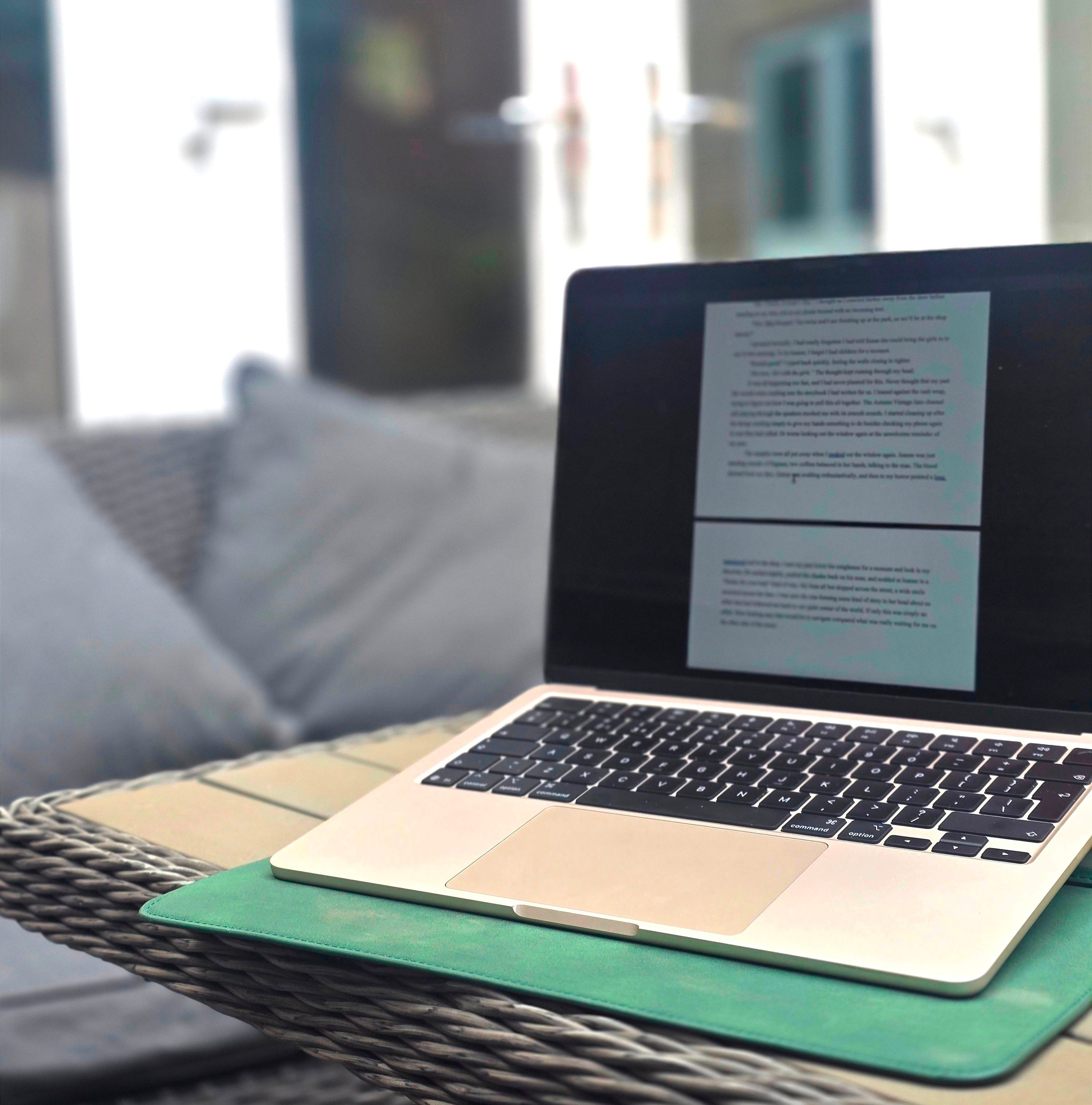
The final challenge was to read the story aloud as though I were standing on stage at a literary festival. I didn’t quite commit to performing it to an imaginary audience, but I did send it to a friend instead. Fortunately, the atmosphere, ambiguity and ending all landed in the way I’d hoped.
I ended up writing far more on this day than the exercise intended. I had the Arvon Saturday Writing Club in the morning, the sun was shining, and I was just inspired to write. By the end of the day the story had grown to around 7800 and I finally felt like I had a complete piece of writing in my hands: a psychological gothic story filled with suspense, ambiguity and far more confidence than I expected when I started the challenge.
My story is called Penelope.
So what did I learn from this experience?
1. I can write a complete story in a week.
On Monday morning I had no idea what I was going to write. By the weekend, I had a finished story. That genuinely surprised me, and I came away feeling an enormous sense of achievement.
2. I can write a short story
I’d never tried before because I’d convinced myself it would require meticulous planning to keep it concise and make every word count. Ironically, having the first and last lines chosen for me gave the story enough structure that I could simply focus on filling in the middle.
3. I still have work to do when it comes to restraint.
Whether this counts as a short story or a novelette, I’m still a bit of a waffler. I suspect many readers would look at any of my writing and say that 20–30% could be cut. Learning when to stop explaining and trust the reader is definitely something I want to keep working on.
4. I can write in different genres.
I hoped this was true, but I think I’d quietly assumed I’d be pigeonholed into speculative fiction because that’s what my novel is. I came away feeling much less worried about being defined by a single genre. If a story wants to become psychological gothic fiction, I’m happy to follow where it leads.
5. I like being held accountable.
No one was checking whether I’d done the work, but doing the challenge alongside my sister, using The Writer’s Journey sessions as dedicated writing time, and knowing a new prompt would arrive in my inbox every morning kept me moving forward. It made me realise how much external structure helps me build momentum and motivation.
If you’re interested in creative writing, I’d really recommend checking out some of the courses that Arvon offer. They have online and residential options, tutored and untutored. Arvon have been a massive influence in my writing journey this year, and all the tutors and course teachers I have encountered have been inclusive, supportive and incredibly knowledgeable.
I would particularly encourage you to try out their Saturday Writing Club, which is a donate what you can session, and enables you to spend an hour once a month writing short creative pieces just for the fun of it, whilst linking up with other writers all over the world. It’s a very low pressure, relaxed way to do some writing with other people.
So yes, apologies again to my 105,000-word speculative fiction novel, which is still waiting patiently for edits, but I have a feeling this won’t be my last detour. I’m already itching to borrow another opening and closing line from a favourite novel and see what happens in between. If this week has taught me anything, it’s that a few constraints can sometimes unlock far more creativity than a completely blank page.
Love this! Thank you for letting us behind the scenes on this challenge, I love the premise of the prompts and where it took you.
Thanks for sharing, Kim! Great prompts!
This is a rare occasion where I’m happy I was able to encourage / facilitate cheating!
“I finished this week with a complete story that I hadn’t planned on writing until Monday morning.”
Wow, how I wish I could say that at the end of every week! Nice work